

The night before a trip I usually end up with forty-seven pins on a map and no idea what order to walk them in.
By then I have read about a church I would otherwise have walked straight past, looked at old photographs of a square, and found a bakery someone swears by and a viewpoint that is supposedly better than the famous one. What I haven’t done is work out how any of it connects. So I spend another hour dragging pins around, guessing which streets are worth taking and which are just the shortest line between two places. I go to bed with a route that will fall apart by lunchtime.
I enjoy that research. But I noticed I was doing the same job before every trip, and the part that took the longest always happened at home, at night, before I had seen a single street. Nadoloni started as an attempt to move that work somewhere else.
A Lisbon checklist tells you where to go, not what to look at
Most lists of things to do in Lisbon look the same: Belém Tower, Jerónimos Monastery, tram 28, São Jorge Castle, a pastel de nata, a miradouro at sunset. Every item on them has earned its place. But a checklist only gets you to each place and says nothing about what to notice once you are standing there.
The things I remember from cities tend to be smaller and stranger, and in Lisbon they came to me as questions.
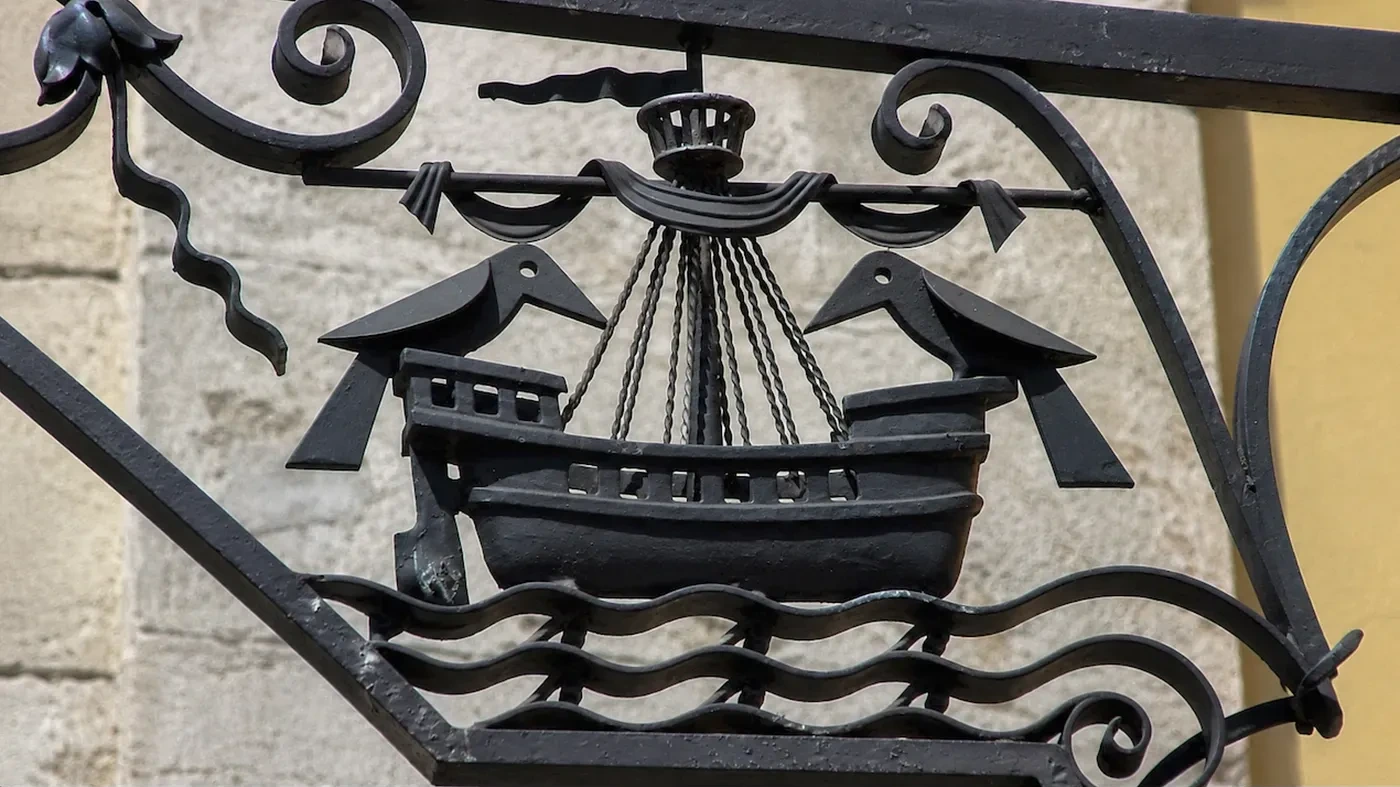
- Why are there ravens on the city’s coat of arms?
- Why does a Gothic church in Chiado stand open to the sky?
- How do you tell a nau from a caravel?
- Why did Portugal and Spain once draw a line through the Atlantic and divide the lands beyond it between themselves?
The church is the Convento do Carmo. Its roof came down on the morning of 1 November 1755, All Saints’ Day, while people were inside for mass, and it was never fully rebuilt. If you walk in knowing that, the pointed arches above your head no longer look like a picturesque ruin. The ravens lead back to a legend about the relics of Saint Vincent arriving in Lisbon by boat, watched over by two birds. Each answer changes the place in front of you a little. It also changes the next street, because you start looking for things you would have missed. That is the experience I built the app around.
A self-guided walking tour where the planning is already done
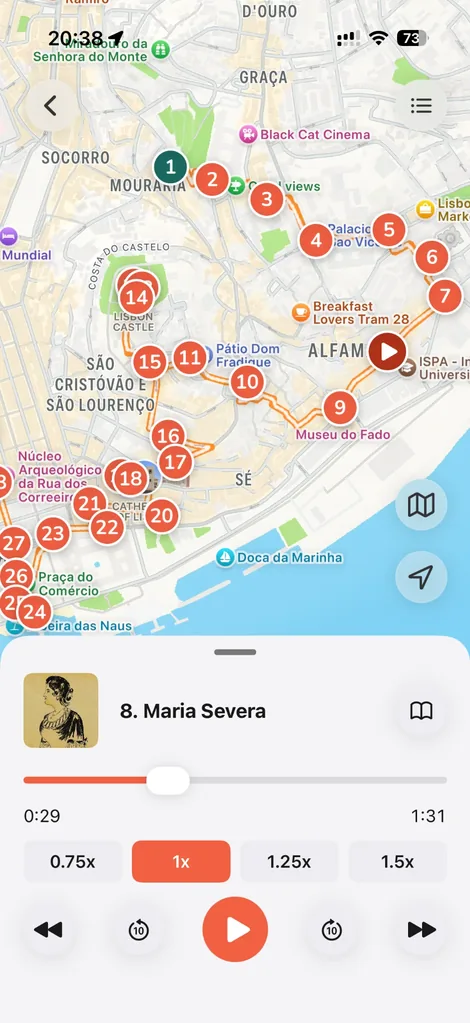
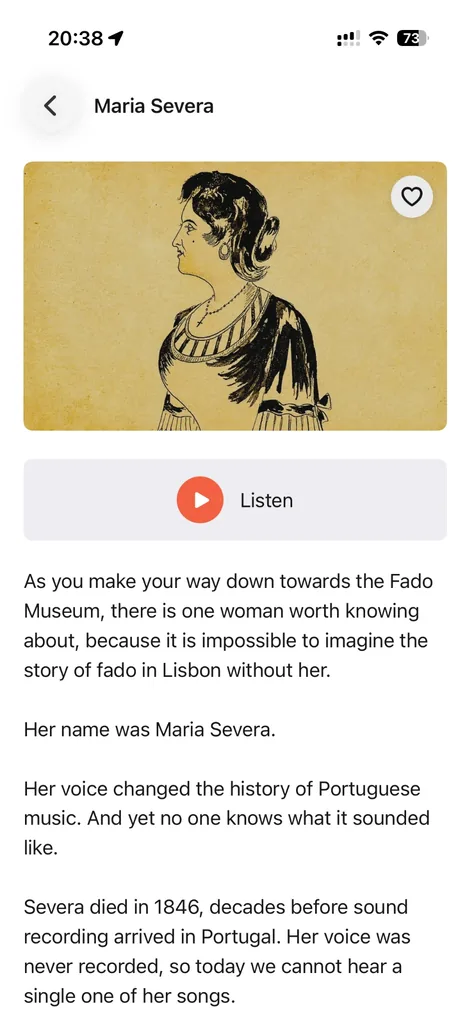
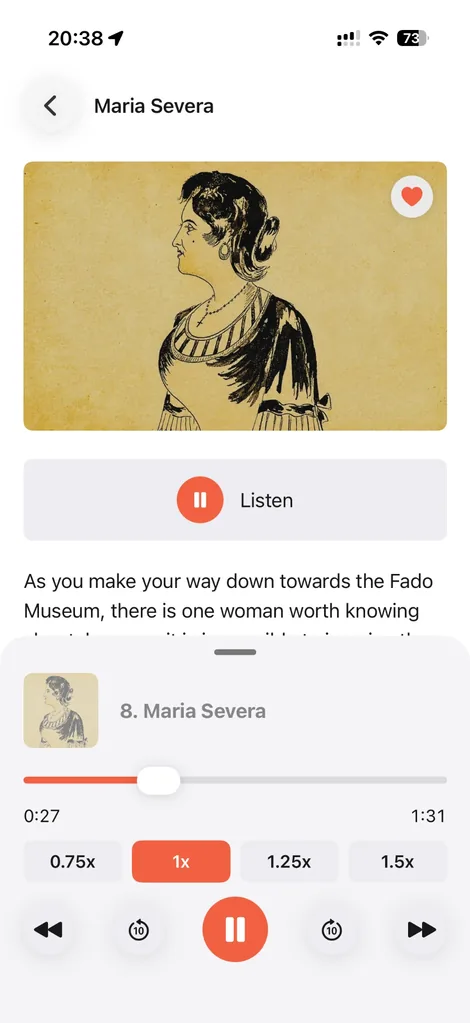
In Nadoloni you pick a route and start walking. The stops are already in order, and the map shows you the way to the next one. When you reach a stop, a short audio story plays about what is in front of you.
You can stop for coffee, go into a shop that catches your eye, or close the app when you have had enough history for the day and pick up from the same stop tomorrow. Nobody is waiting for you at the next corner with an umbrella in the air.
89 stops across Lisbon’s historic centre, Alfama and Belém
The Lisbon guide has two routes, one through the historic centre, including Alfama, and one through Belém, with 89 stops between them.
Researching them changed a city I thought I knew. A single street could belong to medieval Lisbon, to the grid laid out under the Marquis of Pombal after the earthquake, and to the present day, all at once. A square you cross in two minutes makes more sense once you know what used to stand on it.
Lisbon has more facts than any walk could hold, so most of the work was deciding what to leave out. Sometimes the question came even earlier: did a story belong on the route at all?
Magellan was one of those cases. He was Portuguese, but the expedition that made him famous sailed for Spain. What kept him in was what came before. In 1505 he sailed out of Lisbon with a Portuguese fleet bound for India. He then spent the next eight years at sea and at war in the East, years before he ever approached the Spanish crown.
His story took me several hours, because almost every detail led to another one. For every stop I kept asking the same thing: after hearing this, will someone look at the place differently? Whatever didn’t pass stayed in my notes.
Short audio stories, so you keep looking up
A long audio guide slowly crowds out the city. You stop looking around and stop hearing the street, and twenty minutes later you realise you have been listening to a file instead of looking at Lisbon. So each story runs one to three minutes: long enough to explain what is in front of you, short enough that you look up while it is still playing.
What I want you to take home from the walk
I don’t expect anyone to remember 89 stories. I want them to remember a handful well enough to tell someone else later: why Carmo has no roof, what the ravens on Lisbon’s coat of arms are doing there, how to tell a nau from a caravel. And I want them to feel the afternoon was well spent, and that the trip was easier because of it.
That is why every stop is built around one idea, and a date or a name stays only if it helps tell that story. The stops are arranged as a route rather than a collection of pins, so one place leads to the next. Every one of them is researched and written by me.
Lisbon comes first because it is the city I know best, and more cities will follow. The first five stories on each route are free, so you can try the format before paying for anything. Nadoloni is now available for iPhone, and you can explore the Lisbon routes here.
If you find yourself in Chiado, walk into the Carmo ruins and look up.
Two self-guided audio walks, 89 stops, and the first five stories on each route free.